Carbon-14 and the Limits of Deep Time
What the clock measures, what it cannot, and where the real question lies
"A false balance is abomination to the LORD: but a just weight is his delight" (Proverbs 11:1). If we are going to weigh the age of a thing, we are bound to use an honest weight. So this page does not start by telling you that radiocarbon dating is a trick. It is not. It is a careful, well-tested method, and the people who do it are, for the most part, doing real science with real rigor. What we want to do here is the harder and more honest thing: understand exactly what the method measures, see the assumptions it rests on with our own eyes, state the strongest answer the mainstream gives, and then look squarely at the one place where the measurement and its interpretation come apart. "Prove all things; hold fast that which is good" (1 Thessalonians 5:21).
1 · What carbon-14 actually measures
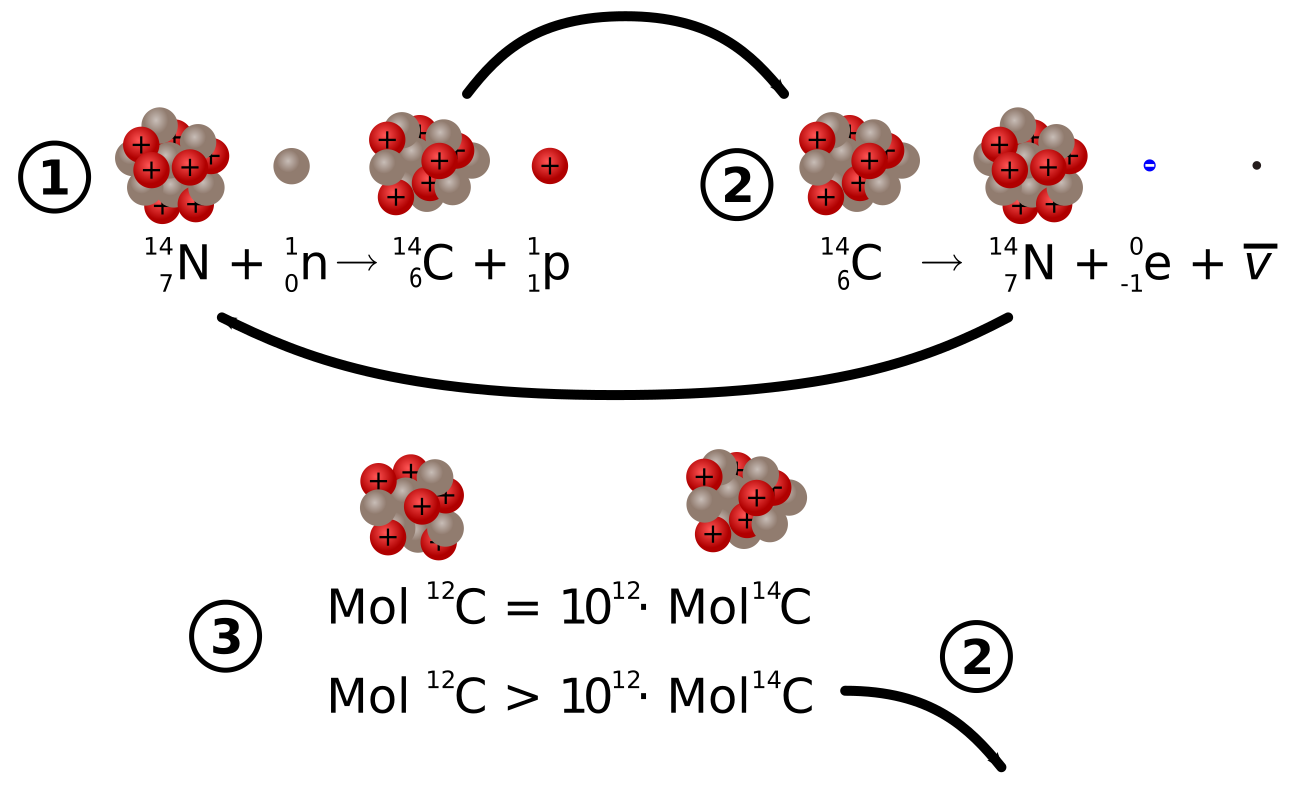
Cosmic rays striking the upper atmosphere knock neutrons loose, and those neutrons hit ordinary nitrogen and turn it into a heavy, unstable form of carbon, carbon-14. A living thing breathes and eats that carbon along with the normal kind, so while it is alive it carries the same tiny ratio of carbon-14 to ordinary carbon as the air around it. When it dies, it stops taking in new carbon, and the carbon-14 it already holds begins to decay back into nitrogen at a fixed, clock-like rate. Measure how much is left, and in principle you can read how long ago the thing died.
The rate is the famous part. Carbon-14 has a half-life of about 5,730 years: every 5,730 years, half of what remains decays away. That is a fast clock, and it is the whole reason carbon-14 is useless for deep time. Watch it run out:
| Half-lives | Years since death | Carbon-14 remaining |
|---|---|---|
| 0 | 0 | 100% |
| 1 | 5,730 | 50% |
| 2 | 11,460 | 25% |
| 3 | 17,190 | 12.5% |
| 5 | 28,650 | 3.1% |
| 8 | 45,840 | 0.39% |
| 10 | 57,300 | 0.098% |
By ten half-lives there is less than one part in a thousand of the original carbon-14 left. That is why the practical ceiling of radiocarbon dating is roughly 50,000 years, with the most careful accelerator work pushing toward 55,000 to 60,000. Past that, there is simply nothing left to measure above the noise. Note what this means before we go further: carbon-14 cannot date a dinosaur on the standard timescale. A bone said to be 66 million years old would be more than eleven thousand half-lives gone: the carbon-14 in it should be, for all practical purposes, exactly zero. Hold on to that; it matters later.
2 · The assumptions the clock rests on
A clock that reads how much carbon-14 is left only tells time if you know how much was there to begin with. And that number is not measured; it is reconstructed. The method assumes the atmosphere's carbon-14 level in the past, and it has to, because no one was there with an instrument. This is not a creationist talking point; it is exactly how the field describes itself. In a 2008 Oxford review of the method, the developer of the standard calibration software writes that, unlike some other dating methods, "with radiocarbon we can only estimate" the starting concentration "from our knowledge of the past environment," and that radiocarbon production "is expected to fluctuate on a whole range of timescales" (Bronk Ramsey, Archaeometry 50:2, 2008).
So the honest list of things that can move a radiocarbon date is real, and it comes straight from the mainstream literature:
- Production has not been constant. The carbon-14 made in the atmosphere rises and falls with the sun's activity and, more powerfully, with the strength of the earth's magnetic field, which shields us from cosmic rays. A stronger past field means less carbon-14 made, which makes old samples read older than they are.
- Reservoirs differ. The deep ocean holds old, carbon-14-poor carbon; sea creatures and anything that ate them can read centuries too old. The field corrects this with a "marine reservoir" offset of roughly 400 years, and it varies by place.
- Contamination can push a date either way. A speck of modern carbon makes an old sample read far too young; old carbon from groundwater or rock makes a young sample read too old. Bone is the worst offender, which is why an entire sub-field exists just to clean it (more on that below).
3 · The strongest answer the mainstream gives, stated fairly
Here is the part a fair page has to include, because it is the heart of why scientists trust the method despite those assumptions: they do not assume a constant atmosphere. They calibrate. Tree rings give a year-by-year record of atmospheric carbon-14 reaching back through the whole Holocene; annually layered ("varved") lake sediments and cave formations and coral extend it further. By measuring the carbon-14 in samples of known calendar age, the field built calibration curves (the IntCal series, most recently IntCal20 in 2020) that translate a raw radiocarbon measurement into a calendar date and back about 55,000 years. When a creationist says "but production wasn't constant," the working scientist answers, correctly, "yes, and that is precisely what the calibration curve corrects for." They even watched the clock get spiked in real time: atmospheric nuclear testing nearly doubled the carbon-14 in the air in the 1960s, a "bomb pulse" that has been tracked ever since.
Within its real range, the last fifty thousand years or so, radiocarbon dating is not a guess. It is cross-checked against tree rings counted one at a time and against several other independent records, and where those records overlap they agree. To wave that away is not faith; it is a false weight. The creation case is not helped by pretending the calibration does not exist.
4 · The case the young-earth reading actually rests on
So where is the live question? Not in the dates of things a few thousand years old, where calibration is strong. It is at the very floor of the method, in materials that, on the standard timescale, should hold no carbon-14 at all, yet are reported to hold a trace. Coal beds said to be hundreds of millions of years old, diamonds said to be a billion, and fossil bone said to be tens of millions of years old have been measured with small but non-zero amounts of carbon-14, typically in the range of 0.1 to 0.5 percent of the modern level (pMC). The most organized presentation of these measurements was the RATE project (Radioisotopes and the Age of The Earth), published by the Institute for Creation Research in 2005, which argued the trace carbon-14 is intrinsic to the samples and therefore that the samples cannot be the age conventional geology assigns them.
The force of the argument is in the same decay math we used above, run backward. A measured level of carbon-14 corresponds to an apparent radiocarbon age, no matter what the material is:
| Carbon-14 measured (pMC) | Apparent radiocarbon age |
|---|---|
| 0.5% | ~43,800 years |
| 0.3% | ~48,000 years |
| 0.1% | ~57,100 years |
| 0.05% | ~62,800 years |
The creationist point is blunt: a diamond is not 57,000 years old on anyone's reckoning, and it is certainly not millions of years old if there is any real carbon-14 in it, because 57,000 years is already past the point where carbon-14 should be gone. If the trace is genuinely part of the sample, the deep-time ages cannot stand.
5 · The honest fault line
Everything turns on one word in that paragraph: if. Both sides agree the instruments are reading something. The whole question is whether that trace carbon-14 was in the sample to begin with or got there some other way. And here the mainstream has real, specific answers, not hand-waving:
- Machine background. An accelerator mass spectrometer does not read true zero. It has its own background, often around 0.05 pMC, from the instrument and the sample chemistry. That alone lands in the same range as many of the reported "ages."
- In-situ production. Carbon-14 is still being made underground, where neutrons from the decay of uranium and thorium in surrounding rock strike nitrogen in the sample. The same 2008 review estimates a steady-state floor from this effect equivalent to a radiocarbon age of roughly 70,000 years for high-nitrogen material, a real, calculated, non-decay source of carbon-14 sitting right where the disputed numbers are (Bronk Ramsey, 2008).
- Contamination, especially in bone. Bone is notoriously hard to date. A 2010 study in Radiocarbon opens by stating flatly that bone dating "has been problematic since the early days," that different fractions of one bone routinely disagree, and that one "must be assumed" that samples have picked up contamination both in the ground and in handling (Cherkinsky & Chataigner, Radiocarbon 52:2, 2010). The reported carbon-14 in dinosaur bone comes from exactly the material the specialists say is hardest to trust.
None of this proves the trace is contamination in every case, and a fair page will not claim it does. What it shows is that there are well-established, non-young-earth explanations for a few tenths of a percent of carbon-14 in an old sample, and that those explanations are strongest precisely for diamonds, coal, and bone. The creation side answers that the contamination story is invoked too readily and is itself an assumption. That back-and-forth is the actual debate. It is a debate about the source of a trace, not about whether the radiocarbon method works.
The honest verdict
Three things are true at once, and intellectual honesty means holding all three.
One: radiocarbon dating is sound within its range, and the common claim that it has been "proven wrong" or rests on a naive constant-atmosphere assumption is not accurate: the calibration curves exist precisely because the atmosphere was not constant. We do not advance the gospel by repeating a debunked version of this. Two: carbon-14 does not, and cannot, date the earth or the dinosaurs; the deep ages come from other methods entirely, so radiocarbon is the wrong tool to settle the age of the world in either direction. Three: the trace-carbon-14 measurements at the floor of the method are real and not yet fully closed, and they are a legitimate place to ask hard questions, while being equally honest that contamination, machine background, and in-situ production are well-grounded explanations that have to be ruled out before "intrinsic" can be claimed.
And here is the line that the rest of this section will hold to: a measurement is not the same as the story we tell about it. The number an instrument prints is testable and repeatable. The history we reconstruct from it (whether a young earth and a global Flood that reordered the carbon reservoir, or millions of years of steady deposition) is an interpretation of evidence about a past no one observed, and every party brings assumptions to it. Scripture says the creation is a true witness: "The heavens declare the glory of God" (Psalm 19:1), and his power is "clearly seen, being understood by the things that are made" (Romans 1:20). Faithful Christians read the age of that creation in more than one way, and the age of the earth has never been the hinge of the faith. What this page asks of the reader is only what Proverbs asks of all of us: a just weight. Weigh the method honestly, weigh the anomalies honestly, and do not call either side fringe to avoid the harder work of looking.
Sources are summarized, not reproduced. Scientific background drawn from C. Bronk Ramsey, "Radiocarbon dating: revolutions in understanding," Archaeometry 50:2 (2008), 249–275, and A. Cherkinsky & C. Chataigner, "14C Ages of Bone Fractions from Armenian Prehistoric Sites," Radiocarbon 52:2 (2010), 569–577; calibration refers to the IntCal20 curve (Reimer et al., 2020). The trace-carbon-14 argument is presented as set out by the RATE project (Institute for Creation Research, 2005); the contamination, in-situ production, and machine-background responses are the standard scientific replies. Half-life 5,730 years; apparent ages computed by standard decay. Scripture quotations from the King James Version, linked to BibleHub. This page reports and weighs the science; it does not present a faith interpretation of earth history as a tested scientific result.