The Distances of the Stars
How we measure them, and the puzzle of starlight in a young universe
"He telleth the number of the stars; he calleth them all by their names" (Psalm 147:4). We cannot do the first thing and we cannot do the second, but we have learned to do something almost as surprising: to measure how far away they are. It is fair to ask how, exactly, anyone knows that a star is four light-years off, or four billion. The honest answer has two halves that are usually run together and should not be. One half is a question of measurement, and there the science is far stronger than skeptics of it allow. The other is a question of time, and there sits a real and openly admitted puzzle for anyone who holds the universe to be young. Let us take them in that order.
1 · How the nearest distances are actually measured
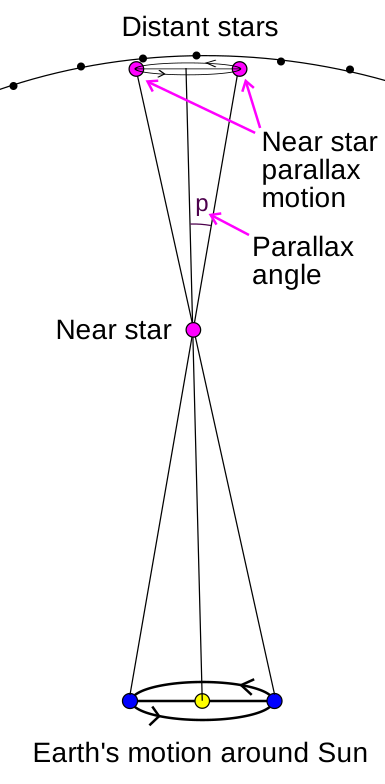
The first rung is pure geometry, and it is honest work. As the Earth swings from one side of its orbit to the other over six months, a nearby star appears to shift its position slightly against the far more distant background, the same way your thumb held at arm's length jumps against the wall when you blink one eye and then the other. Measure the tiny shift, know the width of Earth's orbit, and trigonometry gives the distance. This is parallax, and the unit it defines, the parsec, just means "the distance at which that shift is one arcsecond."
Now, the skeptic's instinct here is a fair one, and it is worth honoring before answering: the angles are absurdly small. Friedrich Bessel measured the first one in 1838, and the very nearest star to the sun, Proxima Centauri, has the largest stellar parallax there is, and it is still less than a single arcsecond, about the angle a coin would make seen from several kilometers away. Every other star is smaller than that. So the worry is reasonable: can we really trust a measurement that fine?
2 · The mainstream answer, which is strong
The answer is yes, and pretending otherwise would be the kind of overreach this section refuses. The European Space Agency's Gaia spacecraft, working above the blurring of the atmosphere, has measured these shifts to about twenty millionths of an arcsecond, charting the positions and distances of nearly two billion stars, each watched dozens of times across years. Its parallaxes are independently cross-checked against other methods and they hold. To wave that away as guesswork is simply false, and a creationist who does it forfeits the right to be heard on anything harder. The distances to the nearer stars are known, and known well.
Here is the legitimate version of the original worry. Direct parallax, even from Gaia, reaches reliably across only a portion of our own galaxy, a galaxy that is itself one among hundreds of billions. The truly vast distances, to other galaxies billions of light-years off, are not measured by parallax at all. They are built up rung by rung on a "distance ladder": parallax calibrates certain pulsing stars, those calibrate exploding stars, those calibrate the redshift of galaxies. Each rung is real science, and each is a step less direct and more dependent on the models behind it than the rung below. So confidence should scale with distance: rock-solid for the neighborhood, strong but more inferential as you go out, and properly humble at the far edge. That is not a creationist talking point; it is how the astronomers themselves describe the ladder.
3 · The real question is not the ruler, it is the clock
Notice that none of this is actually the young-earth problem. Even if every distance were certain, the believer who holds to a recent creation faces a sharper difficulty, and it is only fair to state it at full strength: if a galaxy is a billion light-years away, its light took, on the face of it, a billion years to get here. How then do we see it, in a universe only thousands of years old? This is the distant-starlight problem, and it is the strongest scientific objection to a young universe there is.
The thing most worth saying about it is that the serious young-earth astronomers do not hide from it. Answers in Genesis and Creation Ministries International discuss it openly, in print, as an unsolved problem with candidate answers and no settled solution. That candor is the right starting posture, and it is the opposite of the caricature.
4 · The proposed answers, screened
Several solutions have been offered, and they do not all deserve equal weight.
- The conventionality of simultaneity (Jason Lisle's ASC). This is the most physics-respectable, because it rests on a genuine and accepted point: the one-way speed of light has never been measured and, by a result going back to Einstein, arguably cannot be without first assuming an answer. We only ever measure the round-trip speed. Lisle builds a cosmology in which light moving toward an observer arrives effectively at once. It is a real argument from real physics, though many find it ad hoc, and even Creation Ministries International is cautious about it. Present it as a serious candidate, not a proof.
- Gravitational time dilation (Russell Humphreys). The proposal that clocks ran at wildly different rates early in creation, so that billions of years passed in the distant universe while days passed here. Worth knowing honestly: Humphreys himself has revised this through more than one model, which tells you it is a live, unfinished line of work, not a closed case.
- Light created already on its way. A popular idea that God made the beams mid-flight. It is best set aside, and notably the young-earth astronomers set it aside themselves, because it would have God showing us supernovae and events that never actually happened, which makes the creation a kind of deception.
- A decaying speed of light (c-decay). Once popular, now abandoned even within creationism as not supported by the data. It belongs on the "do not use" list, and the better creation scientists have put it there.
The honest verdict
Two clean conclusions, kept apart. On measurement: the distances to the nearer stars are genuinely known, by geometry a schoolchild could follow and instruments of staggering precision; the only fair caution is that the largest distances ride a ladder of less-direct steps, so humility should grow with the light-years. To deny the measurements is to lose credibility for nothing. On time: the distant-starlight problem is real, and it is the best card the other side holds against a young universe. Its honest handlers admit it is unsolved, offer one or two physics-respectable ideas, and throw out the bad ones. A believer can hold the universe young and the problem genuinely open, without either pretending it is solved or pretending it does not exist.
And the line the whole section has kept holds once more. The shift of a star against the dark is a measurement. The age of the light is, in part, an inference, and where it touches the unobservable beginning it runs past what any instrument can check, for every party. None of it touches the One the light was made to point to. "Lift up your eyes on high, and behold who hath created these things, that bringeth out their host by number: he calleth them all by names by the greatness of his might" (Isaiah 40:26). Whether the number is near or unthinkably far, the heavens are still telling the same glory (Psalm 19:1), and the honest study of their distance, with its certainties and its open puzzle both, takes nothing from it.
Sources are summarized, not reproduced. Mainstream astronomy: the parallax method (F. Bessel, 1838) and the ESA Gaia mission's microarcsecond astrometry of ~1.8 billion stars and the cosmic distance ladder it calibrates. The distant-starlight problem and its proposed solutions are presented as set out by young-earth astronomers themselves, chiefly Answers in Genesis and Creation Ministries International, including J. Lisle's anisotropic synchrony convention and R. Humphreys' relativistic-cosmology models; c-decay (B. Setterfield) and the "light created en route" idea are noted as discarded by creationists as well as critics. Scripture from the King James Version, linked to BibleHub. This page reports the science and states a faith-held young universe as faith, not as a tested scientific result.