Polystrate Fossils
Trees standing through many layers: what they prove, and what they don't
In a few famous places, the sea cliffs at Joggins in Nova Scotia are the classic one, fossil tree trunks stand upright, running straight up through many feet of sedimentary rock, cutting across layer after layer that, on the usual telling, each took a long age to accumulate. The point pressed by creationists is simple and, as far as it goes, sound: a dead tree left standing in the open does not wait patiently for thousands of years while sediment buries it inch by inch. It rots and falls first. So a trunk preserved whole through many layers means those layers piled up fast. That much is right. The honest question is how much it proves, and the answer is: an important thing, but not the thing it is usually marshaled for.
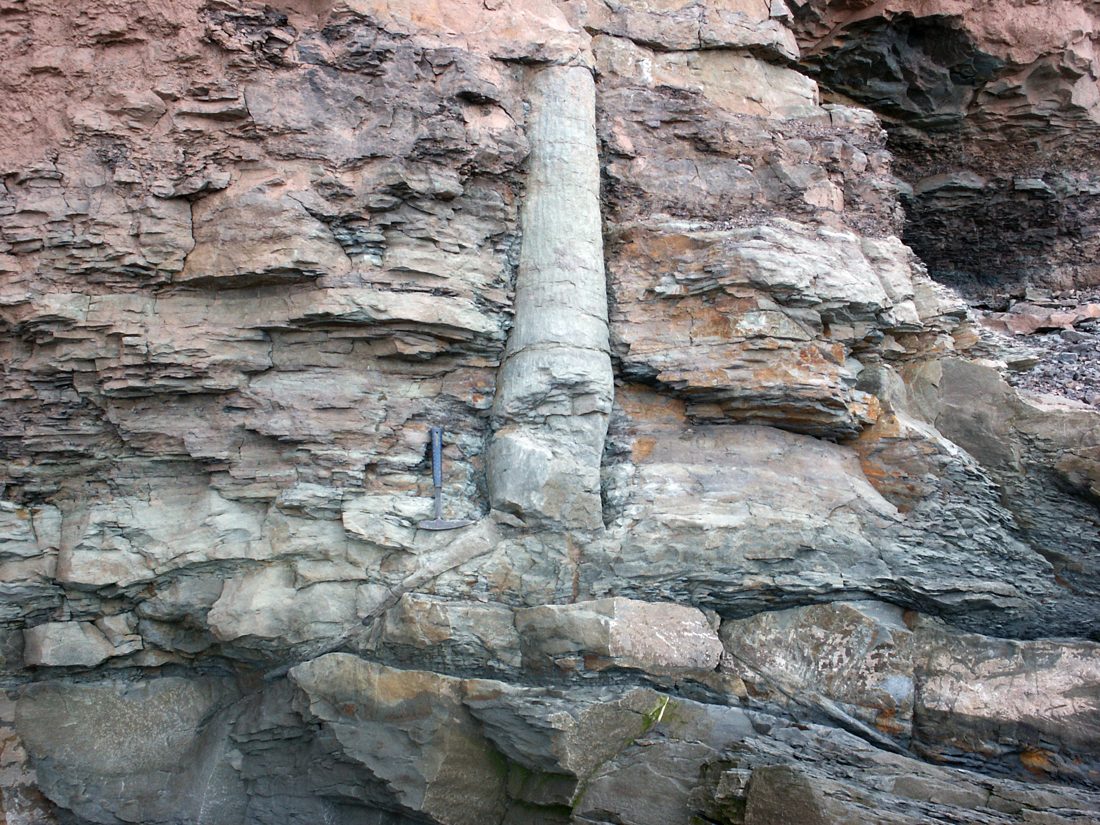
1 · The part everyone actually grants
Rapid burial is not in dispute. Mainstream geology fully agrees that an upright tree crossing several layers was buried quickly: in years or decades, by a sudden influx of sediment (a flooding river breaking its banks into a swamp, an ash fall, a collapsing bank), not over the long ages it might take to build a thick formation elsewhere. The 1980 eruption of Mount St. Helens drove the lesson home in real time: it laid down many fine layers in hours and floated thousands of upright logs onto a lakebed, some of which sank root-down to be buried standing. Nobody has to choose between "slow always" and "a global flood." Local catastrophe is ordinary, and the rock record is full of it. The naive picture in which every single layer equals a vast age is a straw man, and the upright trees knock it down fairly.
2 · The part it does not reach
What the trees do not establish is one worldwide flood, or a young earth. Look closely at Joggins and you find not a single buried forest but many of them, stacked one above another: a forest grows, is drowned and buried fast, the swamp fills, a new forest grows on top, and the cycle repeats, dozens of times up the cliff. Each burial was quick; the whole sequence records many separate quick events with growth in between, adding up to a long total span. A single year-long flood does not grow a forest, drown it, grow another on its grave, and do it over and over. So the same fact that refutes "slow and only slow" also refutes "one flood did everything." It points to a record punctuated by catastrophe, which is a real and interesting thing to learn, and not to the particular conclusion it is most often quoted for.
The honest verdict
So the upright trees earn the creationist a genuine point and deny him an overreach in the same breath. The point is real: catastrophe is common in the strata, sudden burial is everywhere, and the old habit of reading every layer as slow and gradual was a bias that needed correcting, the same lesson the Ice Age megafloods taught the geologists who once called catastrophe heresy (see the Flood page). The overreach is just as real: a record of many rapid events spread through time is not a record of one flood in one year. The same trees stand in front of both readings; the honest move is to take the lesson they actually teach and leave the one they don't. A calculation is not a conclusion, and neither is a striking photograph.
Joggins Fossil Cliffs (Nova Scotia, a UNESCO World Heritage site) and the Mount St. Helens deposits are described as standard geology reports them: rapid local burial of upright trees is uncontroversial, and the Joggins section preserves many stacked fossil forests rather than a single event. The legitimate point (catastrophic, rapid deposition is common and was long under-weighted) is distinguished here from the overreach (a single global flood), in keeping with the site's credibility-first standard.