Noah's Flood and the Rocks
Weighing the flood-geology evidence, one honest claim at a time
I take the Flood of Noah as real history, and I think the modern habit of imagining only slow, gentle change has badly undersold how much of the earth's surface was laid down fast and violently. The rocks are full of catastrophe. But conviction is not a license to overstate, and the surest way to lose a hearing is to swing an argument that has a well-known answer as though it had none. So this page does what the rest of this section does: it states the strongest creation-science case it can, states the mainstream answer fairly, and then asks of each popular proof a single hard question, the one that decides whether it belongs in a serious conversation.
Three kinds of source get three kinds of weight. Mainstream consensus (the geological surveys, the peer-reviewed journals) is stated fairly and accurately, always. Legitimate creation science (Answers in Genesis, the Institute for Creation Research, Creation Ministries International) is a sourced minority case that owns its minority status and meets the best rebuttal head-on. Debunked claims are not given equal standing; at most they are named and answered. The gate for every argument below is the same: does it survive honest contact with the strongest mainstream reply? If yes, both sides are given. If no, it is flagged as a popular claim with a known answer. Tellingly, the leading creation groups themselves publish lists of "arguments creationists should NOT use" for exactly this reason.
1 · What both sides actually agree on
More is shared here than the shouting suggests. Mainstream geology and flood geology agree that vast stretches of every continent are blanketed in marine sedimentary rock, laid down under water. They agree that some of those beds were deposited rapidly and that many fossils had to be buried fast, before they could rot or be scattered, to be preserved at all. The slow-and-only-slow picture that ruled geology in the 1800s has itself been corrected by mainstream science: today's geologists freely invoke catastrophic megafloods, debris flows, and turbidity currents. The disagreement is not "fast versus slow." It is how much of the record is one event and how old it all is. Keep that in view; it is where most of the confusion lives.
2 · Marine fossils on the mountaintops
It is one of the oldest and most striking observations: seashells and the bones of sea creatures sit on the tops of mountains. Near the summit of Everest is the Qomolangma Limestone, packed with the shells of trilobites and crinoids from a shallow sea. The believer looks at that and thinks of "the waters prevailed… and all the high hills… were covered" (Genesis 7:19).
Now the mainstream answer, stated straight, because it is a strong one. That limestone was not dropped on the peak by a flood. It formed on an ancient sea floor and was then lifted there. When the Indian plate collided with Asia, it drove the old seabed of the Tethys Ocean upward over millions of years to make the Himalayas, which are still rising about a centimeter a year. The marine rock on Everest was in fact one of the early clues that led geologists to plate tectonics in the first place.
This is a case where the popular form of the argument does not survive the gate. "Sea fossils on a mountain prove a global flood" is answered cleanly by uplift; the fossils show the rock was once a sea floor, not that a flood reached the summit. What genuinely remains, and is worth keeping, is the larger fact in section 1: marine rock covers the continents on a scale that says the seas once stood where the land is now. That is real, and it is congenial to the Flood account, but the mountaintop shell by itself is not the proof it is often made to be.
3 · The Grand Canyon
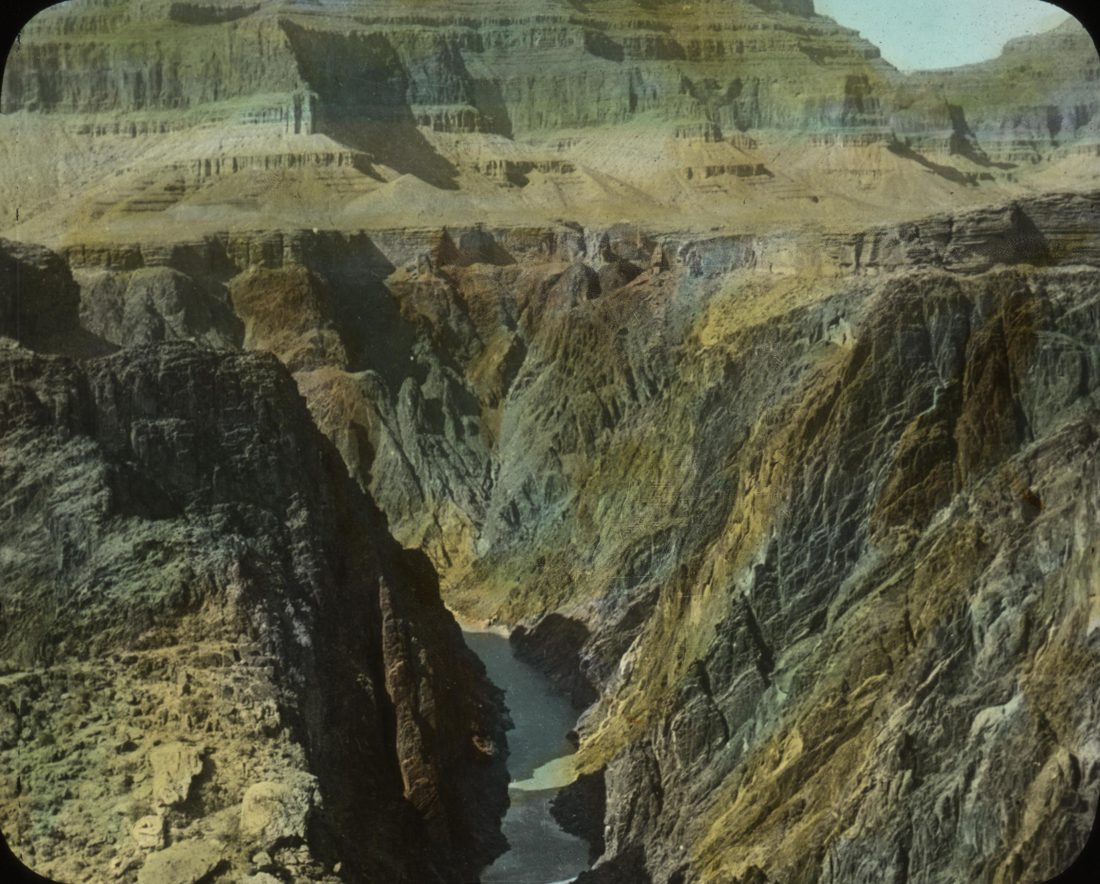
The strongest creation-science treatment is the geologist Steve Austin's Grand Canyon: Monument to Catastrophe (ICR, 1994): the thick stack of strata was deposited rapidly in the Flood, and the canyon itself was then cut quickly afterward, as a large body of trapped water breached and drained. The supporting picture most people have seen is from Mount St. Helens, where in 1982 a mudflow carved a system of canyons up to about forty meters deep through fresh volcanic deposits in a matter of days. That is a real and important demonstration: given the right material, a canyon can form fast.
The mainstream reply has two parts, and both are fair. First, the Mount St. Helens canyons were cut through soft, unconsolidated ash; the Grand Canyon is carved through hard, lithified rock, and it carries features (deeply incised meanders, an intricate network of side canyons, and no enormous debris fan at its mouth) that a single fast drainage does not easily explain. Second, and bigger, the rock layers the canyon exposes run, in the standard timescale, from the Cambrian to the Permian, hundreds of millions of years of deposition, dated by several independent methods. Even among mainstream geologists the timing of the carving is genuinely debated, but the antiquity of the layers is not seriously in dispute there.
Rapid carving is possible in principle, and Mount St. Helens proves it; that point stands and is worth making. Whether the specific hard-rock Grand Canyon was cut that way is contested and not settled by the analogy alone. The deeper question is not the canyon but the layers it cuts through, and that is the real argument, taken up under dating and in the work below.
4 · Polystrate trees
At Joggins, Nova Scotia, and elsewhere, upright fossil tree trunks stand through several layers of rock at once, the so-called polystrate fossils. A tree cannot stand exposed for the thousands of years those layers are supposed to represent without rotting, so creation scientists argue, rightly, that each such tree was buried fast. It is a clean, intuitive point in favor of rapid deposition.
And the mainstream agrees with the core of it: those trees were buried rapidly. The dispute is over how much that proves. Geologists who have mapped Joggins in detail (Waldron and Rygel among them) describe a coastal basin that was sinking quickly, where river floods could bury a standing forest in one event, then quiet returned and another forest grew, again and again. The cliffs record many such cycles, with coal seams that are the remains of long-lived swamps, not a single year's deluge.
The rapid-burial point is true and is granted on all sides. What the trees do not establish by themselves is that the whole rock column went down in one global flood; the same outcrops show repeated cycles of burial and regrowth. So polystrate fossils are a fair, surviving argument for local catastrophe, and an overreach if pressed into proof of a one-year worldwide event.
5 · The mark of a serious case: it polices itself
One reason to take legitimate creation science seriously rather than dismiss it is that its better practitioners do the very gating this page is doing. Answers in Genesis and Creation Ministries International both publish standing lists of "arguments creationists should not use," retiring claims that are outdated or simply wrong. Answers in Genesis has even run an article on the Coconino Sandstone in the Grand Canyon under the honest headline asking whether it is "the most powerful argument against the Flood," and engaged the cross-bedding evidence rather than hiding from it. That willingness to name your own weakest arguments is not a sign of a weak position. It is the only thing that earns a strong one a hearing.
6 · On consistency, and on what we still do not know
There is a fair charge to lay on the other side of the table, too. When planetary scientists look at the giant channels carved into the surface of Mars, they read them without hesitation as the work of sudden, catastrophic floods of water on a scale the Earth has rarely matched. Yet for a long time geologists refused to read the Earth's own landscape that way, and the story of how they were forced to is worth telling, because it answers the point exactly.
In 1923 a geologist named J Harlen Bretz argued that the strange scoured "scablands" of eastern Washington had been cut not by slow rivers over ages but by a sudden, enormous flood. The establishment treated the idea as, in their own words, "unthinkable heresy," and resisted it for some forty years on the principle that slow present-day processes must account for the past. They were wrong. Bretz was right: a glacial lake had burst and stripped the land in days. In 1965 the last holdouts went to see the evidence and conceded; in 1979, at the age of ninety-six, Bretz was given geology's highest award, remarking that he had helped in "challenging a too rigorous uniformitarianism." And here is the part that speaks straight to Mars: when scientists later set out to interpret those Martian flood channels, the working model they reached for was Bretz's Earth scablands. The catastrophic reading ran from Earth to Mars, not the reverse. So the believer who senses a double standard is half right: mainstream science did, for decades, dogmatically resist catastrophe on its own planet, which is precisely the bias creation scientists have long complained of. It is also half wrong, because science corrected itself, and the great Ice Age megafloods are now textbook. The lesson is not that the scientists are fools. It is that one ruling assumption, slow and only slow, blinded careful people to a catastrophe written plainly in the ground, until the evidence broke the spell.
And there is a humility in this for everyone. We have mapped a great deal, yet less than a third of our own ocean floor is charted in any real detail, and the rock beneath the Antarctic ice is the least-known solid surface on the planet, read only through scattered lines of radar. We have stood at the bottom of the deepest trench only a few times. A science still discovering the shape of its own seabed should hold its pronouncements about the deep past, and about worlds millions of miles away, with a matching restraint. That cuts against the overconfident creationist and the overconfident skeptic alike. The honest posture, on the age of a canyon or the history of a planet, is to follow the evidence as far as it goes and to say plainly where it runs out.
This page has weighed the geological evidence. The companion page How the Great Flood Happened takes up the mechanism, catastrophic plate tectonics, the pre-Flood world of lower (not absent) mountains, and the vapor-canopy idea many of us were taught in Sunday school: the story of a water-vapor layer over the early earth, and the honest finish, that the creation scientists themselves retired it once the trapped heat proved fatal. The story, and where the evidence stands, are told there.
The honest verdict
The legitimate core stands, and it is not small: catastrophe and rapid burial are written all over the rock record, the continents are sheeted in marine sediment, and the gentle, slow-only geology of two centuries ago was wrong about that, by the admission of mainstream science itself. The Flood of Noah is a coherent reading of those facts, held by serious people who do real fieldwork. At the same time, the most popular knock-down proofs, the shell on the peak, the canyon cut in a day, the buried tree, each have a real and specific mainstream answer, and honesty requires handing the answer over along with the claim. Used that way, with their limits attached, they are fair contributions to a live argument. Used as slam dunks, they hand the skeptic an easy win and cost us the credibility we need.
And the line this whole section keeps holds here too. What the rocks plainly show, marine beds across the continents, rapid burial, real catastrophe, is one thing, and it is data. How old they are and whether one flood account for them is an interpretation laid over that data, and every party brings assumptions to it. Scripture treats the Flood as history and warns against a studied forgetfulness of it: scoffers "willingly are ignorant of" the fact that "the world that then was, being overflowed with water, perished" (2 Peter 3:5-6). I hold the account as true. I also hold that the case for it is made stronger, not weaker, by refusing to claim one inch more than the evidence will bear.
Sources are summarized, not reproduced. Mainstream geology: the Ordovician marine limestone of the Everest summit and its tectonic uplift (IUGS Geoheritage; standard plate-tectonic accounts); the Cambrian-to-Permian Grand Canyon sequence and Colorado River incision (US Geological Survey / National Park Service); the rapid-subsidence interpretation of the Joggins upright forests (Waldron & Rygel). Creation-science case: S. Austin, Grand Canyon: Monument to Catastrophe (Institute for Creation Research, 1994) and the Mount St. Helens canyon observations; polystrate-fossil articles from ICR and Creation Ministries International; the "arguments to avoid" lists and the Coconino Sandstone discussion published by Answers in Genesis and Creation Ministries International. Scripture from the King James Version, linked to BibleHub. This page treats the Flood as history held by faith and weighs the geological arguments on their merits; it does not present that faith reading as a tested, repeatable scientific result.