Microevolution, Yes; Macroevolution?
What everyone agrees on, and the one leap that is still in dispute
I want to be careful and fair on this one, because it is the place where I differ from the mainstream and also the place where careless arguments have done the most damage to the Christian case. So let me start by giving away everything I can honestly give away, name the mainstream's strongest evidence at full strength, and only then say where I think the case for it actually runs out. The disagreement is real, but it is much narrower than the shouting suggests, and pretending it is wider helps no one.
1 · What is no longer in dispute
Mutations happen. Natural selection happens. Populations change, and new species form: that is observed, in the lab and in the wild, and I do not dispute a word of it. What is striking is that the modern creation movement does not dispute it either; if anything it now leans on rapid change. Young-earth biology has the animals coming off Noah's Ark as a few thousand original "kinds" that then diversified into today's millions of species in a few thousand years, which requires speciation faster than mainstream biology asks for. So "microevolution," change and speciation within a family of creatures, is simply common ground. If anyone tells you creationists deny that species change, they are arguing with a position almost no one holds.
2 · The claim I am actually making
The dispute is about one word: how far. The mainstream holds that the same small steps, given hundreds of millions of years, carry life across every boundary: that fish became amphibians, that a land mammal's descendants became whales, and that all of it, beetle and oak and human, traces back to one common ancestor. That is "macroevolution," or universal common descent. The creation reading draws a line: change and speciation occur freely within an original created kind (Genesis says each brings forth "after his kind," Genesis 1:24), but the kinds themselves did not arise from one another. My claim is not that change has limits I can draw on a chart; it is that the leap from the small change we watch to the universal tree we are shown is an inference, a very large one, and I am not convinced the evidence carries it. Now let me show you why a fair person finds that hard to say.
3 · The mainstream case, at full strength
It will not do to wave this away, so I will state it as strongly as I can. The fossil record does contain forms that sit, anatomically, right between major groups:
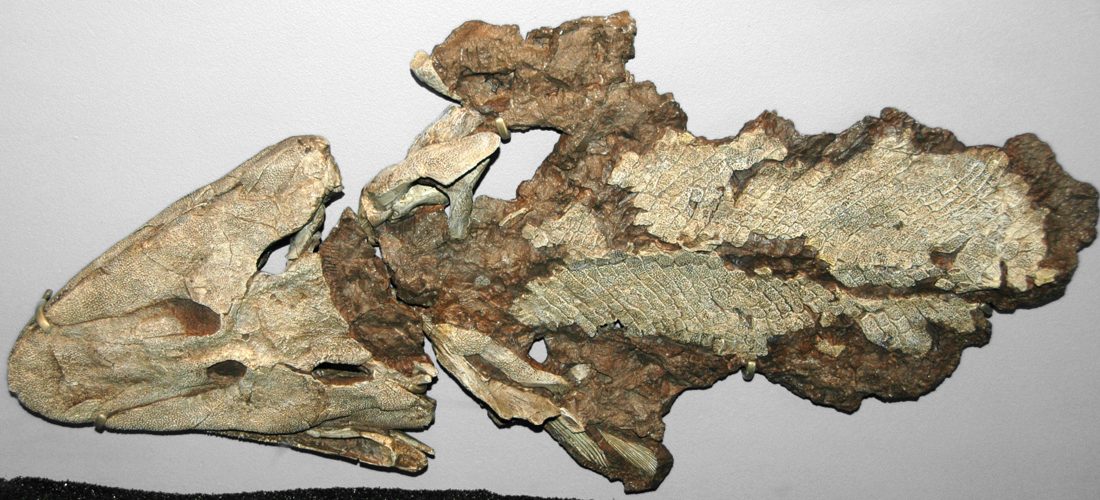
- Tiktaalik (about 375 million years on the standard scale): a fish with a neck, a flat head, and sturdy front fins built on the same bones as a limb. It was even predicted to exist in rocks of that age before it was dug up in 2004, which is the kind of successful prediction that science rightly prizes.
- The whale series: Pakicetus, a four-legged land animal with a whale's distinctive ear; then Ambulocetus, a "walking whale"; then forms with shrinking legs, down to fully marine whales. A graded sequence from land to sea.
- Archaeopteryx (about 150 million years): feathers and a wishbone, but also teeth, claws, and a long bony tail; a mosaic of bird and dinosaur.
- The hominin fossils: forms like Australopithecus ("Lucy," about 3.2 million years) that walked upright on a small, ape-sized brain.
Add to the bones two more things. First, biology can now show new genetic information arising: a gene gets accidentally duplicated, and the spare copy is free to take on a new job, an idea worked out by Susumu Ohno in 1970 and since seen in real genomes. Second, and most pointed, mainstream biologists argue there is no known barrier: if small changes accumulate, what law stops them at the edge of a "kind"? Name the wall, they say, or concede the road runs all the way. These are serious arguments, and an honest creationist has to feel their weight.
4 · Where the popular creation arguments go wrong
Before I give my side, I have to clear away the bad arguments on it, because they are the reason this whole position is so easily dismissed. Three claims you will hear should be dropped:
- "There are no transitional fossils." This is just not true; Tiktaalik and the whale series are exactly that, and saying otherwise forfeits your credibility on the first sentence. The honest claim is narrower: that the record is patchier than a smooth tree would predict, and that reading a fossil as an ancestor rather than a cousin involves interpretation.
- "Mutations never add information." Gene duplication and subsequent change do add it; this one is on the creation organizations' own "arguments to be careful with" lists. The sharper question is whether such steps can build genuinely new, complex, integrated body plans, not whether any new information ever appears.
- "No beneficial mutations exist." They plainly do. The real question is about their reach, not their existence.
If we cannot say these things plainly, we have no business asking the other side to be honest about its gaps.
5 · Where the case for limits still stands
With the underbrush cleared, here is what I think genuinely remains. The strongest version of the design intuition is not about a single fossil; it is about the origin of fundamentally new body plans and the integrated information they require. The fossil record's most awkward moment for a slow tree is the Cambrian explosion, where most major animal body plans appear in a geologically short window without the long graded lineups one would most like to see. And the deeper one looks into the cell (coded information, error-correction, machines that require many matched parts) the more the question presses: can the duplicate-and-tinker mechanism, real as it is at small scale, actually compose architecture of that order, or only vary what already exists? The mainstream answer is "yes, given deep time"; mine is "that is the very thing being assumed, and it has not been shown the way speciation has been shown." That is a narrower, more honest claim than "no transitional fossils," and it is the one worth having.
The honest verdict
So, plainly. Microevolution, mutation, variation, speciation, is real, observed, and granted by everyone, including young-earth biology, which now needs it to run fast. The fight is only over the extrapolation to universal common descent. There the mainstream has a genuinely substantial case (real transitional fossils, demonstrable new genetic information, and a fair challenge to name the barrier) and no one keeps any credibility by pretending otherwise. What I hold, and hold honestly, is that the case is an inference from the small to the all-encompassing, strongest at the level of variation and weakest exactly where it matters most, at the origin of new body plans and new information; and that the Cambrian pattern and the information problem are real soft spots, not yet the slam-dunk they are often presented as.
And the line this whole section keeps holds here too. The nested similarities of living things, in their bones and in their genes, are data; both sides are looking at the same tree. Whether it is a tree of universal common descent or a pattern of common design within created kinds is the interpretation laid over the data, and each side brings assumptions to it. Faithful Christians read it both ways (some hold an old earth and common descent under God's hand, some hold to created kinds) and the age of the earth and the route of creation have never been the hinge of the faith. "And God said, Let the earth bring forth the living creature after his kind" (Genesis 1:24). I read that as a real boundary; I also read it without contempt for the brother who reads it otherwise, and without dropping a true fact to defend it.
See also Genetic Entropy, the claim that the genome is running down rather than up. Sources are summarized, not reproduced. Mainstream evidence: the transitional fossils Tiktaalik (Shubin et al., 2004), the archaeocete whale series (Pakicetus / Ambulocetus / Basilosaurus), Archaeopteryx, and Australopithecus ("Lucy"); new-information mechanisms via gene duplication (S. Ohno, 1970); the micro-macro continuum and the "name the barrier" argument as put by the National Center for Science Education and BioLogos. Creation case: the "created kinds" / baraminology framework and the speciation-within-kinds position (Answers in Genesis, Creation Ministries International), whose own "arguments to avoid" lists are cited for the claims dropped above. Scripture from the King James Version, linked to BibleHub. This page weighs the evidence and states a faith reading as a reasonable inference, not a tested, repeatable result.