The Tornado in the Junkyard
Chance, selection, and the real odds of life
I grew up in the church, but not with this question settled. The tradition that raised me had long since made its peace with evolution, and my schooling was secular, so the account of where the world came from that I was handed as a boy was the ordinary secular one, and for a long time I took it as simply settled, the way you take the floor for granted until it moves. It was as a grown man, reading for myself instead of taking anyone's word for it, that the settled story began to come apart. One of the early books that cracked it open was James Perloff's Tornado in a Junkyard (1999). I do not lean on it now the way I did then, and nothing on this page rests on it. But it put a name to a question I had not known how to ask, and it sent me to the numbers. So let me show you the numbers, and let me also show you the one honest answer to them, because a page that hides the answer is not worth reading.
1 · The image
The picture is older than Perloff's book. The astronomer Sir Fred Hoyle put it in print in The Intelligent Universe (1983): the chance that life assembled itself from raw chemistry, he said, is like the chance that a tornado sweeping through a junkyard would assemble a working Boeing 747 out of the scrap. It is worth knowing that Hoyle was not a creationist; he used the image to argue that life must have drifted in from space, not that Genesis is literal. The intuition, though, is what stuck, and it is a fair one to test: parts that only work when all of them are present and in order do not tend to fall together by accident. Perloff took the picture and made the popular Christian case from it; see his book for the fuller treatment. Here we will do the harder thing and actually run the arithmetic.
2 · The numbers, shown plainly
Start with one modest protein, a chain 150 amino acids long. At each link, life chooses from 20 amino acids, so the number of possible chains of that length is 20150, which is about 10195: a 1 followed by 195 zeros. Most of those chains are useless, of course, so the fair question is not "how many chains are there" but "how rare is a working one." The best peer-reviewed attempt to measure that, by Douglas Axe in the Journal of Molecular Biology (2004), put the fraction of 150-residue sequences that fold into a functional shape at roughly 1 in 1077. Hold that next to what the whole universe can actually try.
| Quantity | Rough size |
|---|---|
| Every physical event the observable universe could run, start to now (particles × age × the fastest possible tick) | about 10140, at the very most 10150 |
| Odds against one working 150-residue protein, by Axe's measured estimate | 1 in 1077 |
| Odds against that same protein if every sequence were counted | 1 in 10195 |
| Odds against a minimal self-copying, code-translating system, by Koonin's estimate | 1 in 101018 |
The first row is the honest ceiling on luck. Counting every particle in the observable universe (about 1080), every second since the Big Bang, and the fastest tick physics allows (the inverse of the Planck time), you get on the order of 10140 total events in cosmic history. The mathematician William Dembski rounds the absolute ceiling up to 10150; the physicist Seth Lloyd, counting it as computation, lands lower, near 10120. Either way, that is the entire budget of chance there has ever been. And it is dwarfed by the numbers beneath it. A budget of 10140 tries cannot be expected to hit a target of 1 in 10195, and against the origin of a first self-reproducing system (Eugene Koonin's figure of 1 in 101018), it is not even in the conversation.
That last figure deserves a name, because it is not from a creationist. Eugene Koonin is a senior mainstream evolutionary biologist. In Biology Direct (2007) he worked out the probability that a coupled replication-and-translation system, the smallest thing that could begin to evolve, would arise by chance, and got less than 1 in 101018, a number so far past the reach of our universe that he proposed escaping it by positing an infinite multiverse, where everything possible happens somewhere. He reaches for infinitely many universes rather than design; that is his prerogative, and it is worth being honest that it is the move a careful evolutionist makes when the arithmetic in this universe runs out. The number is not in dispute. Only what to do about it is.
3 · The answer that actually answers
Now the part a fair page is bound to put squarely on the table, because it is the real reply and most popular versions of the tornado argument never mention it. No serious scientist claims the 747 assembles in one gust. The whole mechanism Darwin proposed is the opposite of a single lucky shot. It is cumulative selection: a small advantage is kept, copied, and built upon, then the next small advantage on top of that, across countless generations. Each step is individually probable; it is the stacking, not a miracle of simultaneous assembly, that produces the complex result. Richard Dawkins made this the center of The Blind Watchmaker, and it is exactly why the junkyard image has a nickname among biologists: Hoyle's fallacy. As an objection to evolution by natural selection, the tornado picture aims at a claim no one is making. It models pure one-step chance; the small-scale change we can observe is not pure one-step chance.
That much has to be granted without flinching: adaptation and microevolution are real, and I do not dispute them. What does not follow automatically is the next and far larger claim: that the same small steps, given deep time, carry one kind of creature across into another, and that the fossils record those crossings. That extrapolation, from the small and observed to the grand and unobserved, is a separate argument and a much more contested one, which the verdict below takes up directly.
The same honesty applies to the protein number. Axe's 1-in-1077 has been seriously contested by other biologists (Arthur Hunt, Dennis Venema, and others) who argue that he measured only one narrow function in one protein and that working sequences may be far more common in the space than his method suggests. We should not present 1077 as a settled fact. It is a serious estimate with a serious dispute attached.
If someone tells you a single tornado built the airplane, the right answer is that no one serious says it did. Against the small-scale change we can actually watch (adaptation, the mutation and reshuffling of genes, a population shifting under pressure), the tornado misses, and Christians do ourselves no favors swinging it there. Selection plainly can stack small steps; that much is observed, and I hold it freely. Two harder questions remain, and they are where this page means to be honest: whether that observed small-scale change can be stretched all the way to the making of entirely new kinds of creature, and what has to be true before selection can begin at all.
4 · Irreducible complexity
That harder question is what the biochemist Michael Behe pressed in Darwin's Black Box (1996) under the name irreducible complexity: a system made of several parts where removing any one stops the whole thing working. His picture is a mousetrap, useless without all its pieces; his biological examples are the rotary motor of the bacterial flagellum, the blood-clotting cascade, and the eye. The argument is that cumulative selection cannot build such a system one part at a time, because the half-built versions do nothing for the creature to select. It is a sharper argument than the tornado, because it grants selection and still asks how the first working version got there. And it has drawn real scientific answers, which honesty requires us to state:
- The eye. Darwin himself took up the eye and argued for a graded series of light-sensing organs, each useful. In 1994, Dan-Eric Nilsson and Susanne Pelger modeled exactly that path, from a flat light-sensitive patch to a focusing camera eye, and estimated it could be crossed in fewer than 400,000 generations: a blink in geological time. Design advocates answer that the model assumed the hardest part, the light-sensitive cell's own biochemistry, rather than explaining it. Both points are fair.
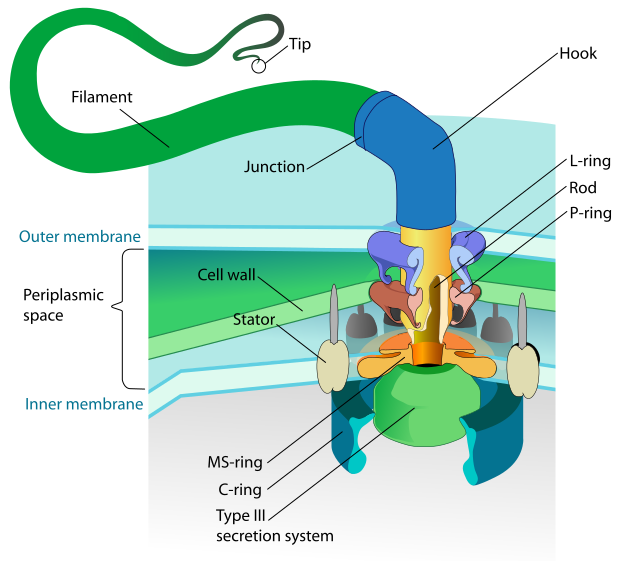
- The flagellum. Kenneth Miller pointed out that a subset of about ten flagellar proteins closely matches the Type III secretion system, a working molecular syringe some bacteria use: evidence that the parts are not single-purpose but can be co-opted. The honest complication, from a 2012 study, is that the secretion system may have descended from the flagellum rather than the reverse, so the precise pathway is still argued. What is clear is that the components are reusable, which is what the irreducibility claim denied.
- Blood clotting. Russell Doolittle spent decades tracing how the cascade could have grown by the duplication and tinkering of existing genes. Behe replied that he had limited his claim to one specific stretch of the pathway that the rebuttal does not touch. This one is genuinely unsettled.
None of these answers is a finished proof, and none should be waved away. They are live science. But notice that in every case the reply depends on the same engine: a population that already copies itself with variation, so selection has something to work on.
5 · Where the argument is actually strong
Here is the hinge, and it is worth seeing clearly. Cumulative selection is a powerful answer, but it only switches on once you already have a thing that reproduces itself with heritable variation. Before that, at the very origin of the first self-copying, code-reading system, there is no selection yet, because there is nothing yet reproducing for selection to favor. At that one point, and only there, the process really is closer to a single shot in the dark, and that is precisely where the numbers are at their worst. It is no accident that Koonin's 1-in-101018 is an origin-of-life figure, and that his escape from it is not natural selection but an infinity of universes. Swung at the small-scale evolution we can watch, the tornado is a weak objection. Swung at the unguided arrival of life (the first replicator, before any selection exists), it is a serious one, and the people who study that arrival most closely concede its force in their own arithmetic.
The honest verdict
Four things, held together. One: as a swing at the change we can actually observe (adaptation and microevolution, which are real and which I hold without reservation), the tornado argument misses, because that change is cumulative selection and not one-step chance; we should stop swinging it there, since overreach only costs us credibility we will need elsewhere. Two: the leap from that observed small-scale change to macroevolution, one kind of creature becoming another across deep time, is a further and separate claim. Mainstream biology considers it well supported and points to transitional forms such as the Tiktaalik fish-to-tetrapod and the whale series; I, with others, find the transitional record sparse and the great crossings unproven. This page reports that as the live disagreement it is, settled in neither direction by assertion. Three: the origin of the first life, before any selection could operate, is where the improbability is real, unanswered by selection, and large enough that a leading secular researcher would rather posit unobservable infinite universes than call it chance in this one, a remarkable concession, and fair to say so. Four: the irreducible-complexity cases are contested on the merits, with proposed pathways that are themselves debated, and intellectual honesty means reporting that neither side has closed the file.
And the same line we drew before holds here. A calculation is not a conclusion. The odds against unguided abiogenesis are a measurement; reading design off of them is an inference (a reasonable one, the inference to the best explanation that improbability plus information points to a mind), but an inference, not a repeatable experiment, and it should be offered as exactly that and no more. Scripture has never asked the believer to win a probability argument. It says the made thing testifies to its Maker: "I will praise thee; for I am fearfully and wonderfully made" (Psalm 139:14), and his power and divinity are "clearly seen, being understood by the things that are made" (Romans 1:20). The numbers do not prove the Maker. They clear the ground, and they make the inference an honest one to draw. That, and not a tornado, is where I came to rest.
See also Specified Complexity, the mathematical form of the same argument. Sources are summarized, not reproduced. The junkyard-747 image is from Fred Hoyle, The Intelligent Universe (1983), used by him to argue panspermia; the popular Christian treatment is James Perloff, Tornado in a Junkyard: The Relentless Myth of Darwinism (1999), cited here only for that argument. Protein-rarity estimate: D. Axe, "Estimating the prevalence of protein sequences adopting functional enzyme folds," J. Mol. Biol. 341 (2004), 1295–1315, with critiques by A. Hunt and D. Venema noted. Origin-of-life probability and the multiverse response: E. Koonin, "The cosmological model of eternal inflation and the transition from chance to biological evolution," Biology Direct 2:15 (2007). Cumulative selection: R. Dawkins, The Blind Watchmaker (1986). Irreducible complexity: M. Behe, Darwin's Black Box (1996); eye model: D. Nilsson & S. Pelger, Proc. R. Soc. Lond. B 256 (1994), 53–58; flagellum / Type III secretion: K. Miller and subsequent phylogenomic work; blood clotting: R. Doolittle. Probability bounds: W. Dembski (10150) and S. Lloyd (10120). Scripture from the King James Version, linked to BibleHub. The opening testimony is the author's own; this page presents a faith inference from the evidence and does not claim it as a tested scientific result.