The Origin of Life
The deepest gap in the story, and how honestly to read it
The tornado page dealt with the odds against life assembling by chance. This one is about the chemistry: the actual research program that tries to get from lifeless molecules to a living cell, what it has and has not achieved, and how a believer should read a problem this hard without falling into the trap of "science can't explain it, therefore God." That trap is real, and avoiding it is most of the work here.
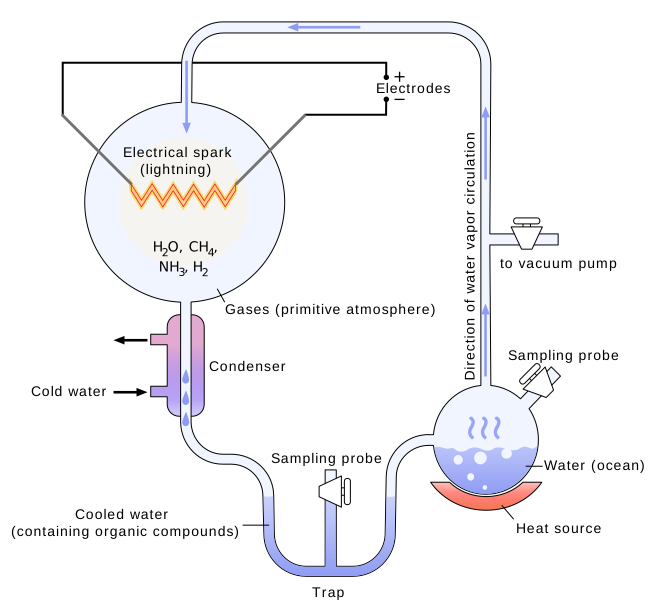
1 · What the famous experiment really showed
In 1953 Stanley Miller ran a spark through a flask of gases meant to mimic the early Earth and produced amino acids, the building blocks of proteins. It is in every textbook, and it was a genuine result. But two things have to be said plainly. First, it made only the building blocks: loose monomers, not a single protein, not a strand of RNA, and nothing remotely alive. Second, the gas mixture Miller used (a strongly "reducing" atmosphere of methane and ammonia) is now thought by most geochemists not to match the real early Earth, which weakens the experiment as a simulation. So the honest headline is not "life was made in a flask"; it is "the easy first step, the raw ingredients, is doable, and the hard steps are still ahead."
2 · The chicken and the egg
The hard step is not the parts but the system. In every living cell, the instructions live in DNA, but reading and copying DNA requires proteins, and building proteins requires the instructions in DNA. Each needs the other already in place: a chicken-and-egg knot at the very root of life. The leading proposal to untie it is the RNA world: the idea that RNA, which can both carry information and act as a catalyst, did both jobs first, before DNA and proteins divided the labor. It is an elegant hypothesis and the best one on offer, and it is also, after decades, unproven: getting RNA to arise and copy itself under realistic conditions has proved very hard.
3 · The problems that will not go quietly
Two difficulties in particular sit at the center, and they are not creationist inventions; the researchers themselves wrestle with them.
- Handedness. Life's amino acids are all "left-handed" and its sugars all "right-handed," but ordinary chemistry makes both versions in equal measure, and a mixture of both will not assemble into working RNA or proteins. How life came to use only one hand ("homochirality") is, in the words of the field, an unsolved puzzle.
- Information. This is the deep one. A cell is not just chemistry; it is chemistry running a code: DNA stores instructions in a four-letter alphabet, read in triplets, translated to proteins by a convention as arbitrary and as real as Morse. Where did the coded information come from? Chemistry can explain the letters; it has not explained the message. This is the heart of Stephen Meyer's argument in Signature in the Cell: that coded information, in every other case we know, traces to a mind, and that no undirected process has been shown to produce it.
4 · Reading the gap honestly
So how should this be weighed? Start with what is not in dispute: the origin of life is an openly unsolved problem. This is not spin; the field says so itself: there is, by its own admission, no consensus mechanism. That candor matters, and it makes the design inference here far more respectable than at, say, the canyon or the dating lab, where the science is settled and the creationist case is weak.
But here is the discipline that keeps the inference honest. "Scientists haven't figured it out yet, therefore God did it" is a bad argument: the god-of-the-gaps, which shrinks every time a gap is filled, and which makes God a placeholder for ignorance rather than the author of all that we do understand. The good version of the design argument is not from absence but from presence: it points to a positive feature of life, the coded information, and says that this kind of thing (a language, a set of instructions) is what minds make, and is unlike anything blind chemistry is known to make. That is an argument from what is there, not merely from what is missing, and it is the only form worth holding, because it does not collapse the day someone synthesizes a self-copying RNA. The chemistry might yet advance a long way; the question of where the information came from is a different kind of question, and the more we learn about the cell as a coded, language-driven machine, the sharper, not the softer, that question becomes.
No one has made life from non-life, and the field admits it has no agreed account of how it happened, so the gap is real and deep. Just don't argue from the gap. Argue from the thing in the gap: a cell runs on coded information, and code is the fingerprint of mind. That case grows stronger as biology advances, instead of weaker, which is exactly what a true argument should do.
The honest verdict
Of everything in this section, the origin of life is, alongside the fine-tuning of the universe, where the case for a Creator stands tallest, not because science has hit a temporary wall, but because what sits at the bottom of life is the very thing we everywhere else associate with intelligence: information, language, a code. The honest believer holds this without triumphalism and without the cheap version of the argument: the field may make real progress on the chemistry, and we should want it to and follow it honestly when it does; but the leap from chemistry to a coded, self-reading system is a genuine and qualitatively distinct problem, and reading a Mind behind that code is a reasonable inference, offered as an inference and not a proof. It is, once more, an old reading. "In the beginning was the Word" (John 1:1), the Logos, the reason and language by which all things were made (John 1:3). That the deepest layer of life turns out to be written in a language is not proof of that verse. It is, again, exactly the kind of thing the verse would lead you to expect.
Sources are summarized, not reproduced. The 1953 experiment is S. Miller's amino-acid synthesis, with the now-standard caveats about the early atmosphere and monomer-only products; the RNA-world hypothesis and the unresolved homochirality problem are presented as the field describes them, including its own acknowledgment of no consensus mechanism. The information argument is from S. Meyer, Signature in the Cell (2009). Scripture from the King James Version, linked to BibleHub. This page presents the design inference as a reasonable, positive inference from coded information, explicitly distinguished from a god-of-the-gaps argument, and not as a tested, repeatable result.