The Cambrian Explosion
The fossil record's most awkward moment, weighed honestly
The macroevolution page named this as the soft spot in the slow-tree picture and promised to come back to it. Here it is. Of all the arguments drawn from fossils, the Cambrian explosion is the one that genuinely troubles a smooth, gradual story of life, and it is also one where the mainstream has real answers that an honest page has to weigh, not wave aside. So this is the design case at close to its fossil best, and the replies to it at their best, side by side.
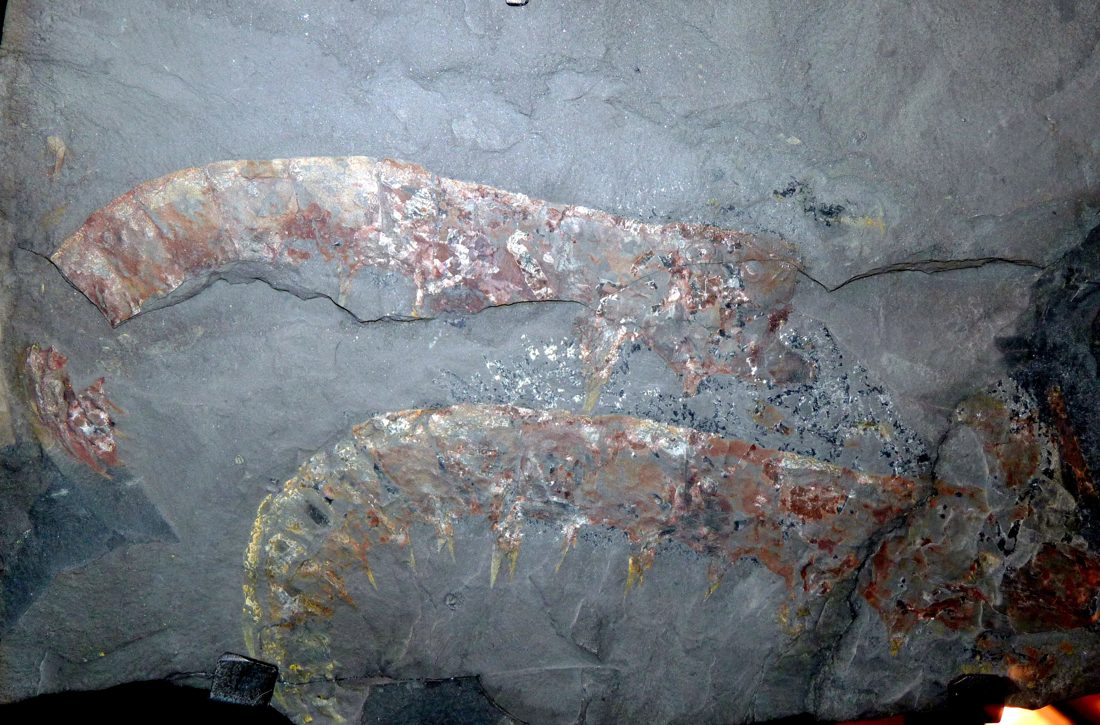
1 · What the rocks show
About 538 million years ago, in a window of perhaps 20 million years or less, a geological eye-blink, the fossil record goes from almost nothing recognizable as complex animals to most of the major body plans we still have: arthropods, mollusks, the first chordates, the basic architectures of some twenty to thirty-five animal groups, appearing in close succession and without the long, graded series of ancestors one would most like to find in the rocks beneath them. Darwin himself flagged it as a difficulty for his theory, and the difficulty has not gone away; if anything, better dating has made the window look shorter. This is not a creationist talking point. It is the textbook description.
2 · The design argument, at its strongest
Stephen Meyer built the most careful version in Darwin's Doubt (2013). The point is not merely that the animals appear suddenly; it is what their appearance requires. A new body plan is not a tweak; it demands large amounts of new, coordinated biological information: new genes, and, harder still, new programs governing how an embryo builds itself. Meyer's claim is that the gradual mechanism has no demonstrated way to generate that much functional, integrated information that fast, and that information of this kind is, everywhere else we find it, the product of a mind. It is the same information argument met at the origin of life, now pressed at the origin of the animal kingdoms, and it is a serious one.
3 · The mainstream answers, fairly stated
And there are serious replies, which honesty requires putting at full strength.
- It is an explosion in slow motion. Twenty million years is an eye-blink to a geologist, but it is an immensity to a population, thousands of times longer than the entire history of our own genus. "Sudden," here, does not mean overnight.
- The record is biased toward hard parts. The Cambrian is when animals first widely evolved shells and mineralized skeletons, exactly the things that fossilize. Soft-bodied ancestors in the Precambrian could have existed and simply left little behind, which would make a gradual arrival look abrupt. The exceptional soft-tissue deposits we do have (like the Burgess Shale) are rare windows, not the norm.
- There is a Precambrian record, and it is filling in. The Ediacaran biota (around 575 million years) show earlier, simpler multicellular life; trace fossils show animals moving before the explosion; and molecular "clocks," which estimate divergence from genetic differences, suggest many animal lineages split well back in the Precambrian, before their fossils appear.
4 · Why it is still a live argument
None of those replies is empty, but none is a clean kill either, and the honest creationist and the honest skeptic both have to admit it. The preservation-bias case is partly an argument from what is missing, the unpreserved ancestors are inferred, not seen, and the Precambrian ancestral forms that the gradual picture needs remain frustratingly sparse and disputed. The molecular clocks disagree with each other and are known sometimes to overestimate. And underneath the timing question sits Meyer's harder one, which the timing answers do not really touch: even granting twenty million years, where does the developmental information for genuinely new body plans come from? That the major designs appear early and then the basic body-plan inventory of the animal kingdom essentially stops expanding, front-loaded rather than slowly accumulating, is a real and unusual shape to the data. It is fair to call the Cambrian a genuine, unfinished problem rather than a settled one.
The Cambrian explosion is real, it is striking, and it is the strongest argument the design side draws from the fossil record: the abrupt arrival of fully-formed body plans, and the deep question of where their information came from. It is also not a knockout, because the mainstream replies (a 20-million-year window, preservation bias, a thickening Precambrian record) are serious. So it lands as it should: a genuine soft spot for a smooth gradual tree, a respectable place to read design, and not a proof: a question worth keeping open, not a verdict to slam down.
The honest verdict
This is one of the places I find the design inference genuinely strong: not because the fossils are missing, but because of what is present and what it would take to build it: whole architectures of animal life, arriving early and integrated, written in the same developmental information whose origin no one has explained by an undirected route. Yet strong is not the same as settled, and a fair reckoning leaves the mainstream with real, if incomplete, answers on the timing. It is worth noting that this is a family argument as much as a faith one: old-earth Christians who fully accept common descent dispute Meyer's conclusion, and they are brothers, not enemies. So I hold it as a live and weighty puzzle, a place where the world looks made, offered as an honest inference and not a closing of the case. "O LORD, how manifold are thy works! in wisdom hast thou made them all" (Psalm 104:24). The sudden garden of Cambrian forms is, at the very least, the kind of thing that verse would lead you to expect, and at most, a fingerprint.
Sources are summarized, not reproduced. The Cambrian timing (~538 Ma; a window on the order of 20 million years; ~20-35 animal phyla) follows standard paleontology. The design argument is from S. Meyer, Darwin's Doubt (2013). The mainstream replies (the duration, the preservation/skeletonization bias, the Ediacaran and trace-fossil record, and molecular-clock deep-divergence estimates) are presented as the paleontological and BioLogos responses; the disagreement among Christians (old-earth reviewers contest Meyer) is noted. Scripture from the King James Version, linked to BibleHub. This page weighs the evidence and offers the design inference as an inference, not a tested, repeatable result.