DNA and the Question of Information
The most modern design argument: a code, or only a metaphor for one?
The origin-of-life page kept circling back to one word: information. This page faces it directly, because it is the heart of the most modern and, to my mind, the most serious argument for design. The claim is simple to state and hard to dismiss: a living cell does not just do chemistry, it runs a program, it stores coded instructions in DNA and executes them, and code, everywhere else we have ever found it, comes from a mind. The work of this page is to state that honestly, and then to give the best objection to it the full hearing it deserves, because the best objection is genuinely interesting.
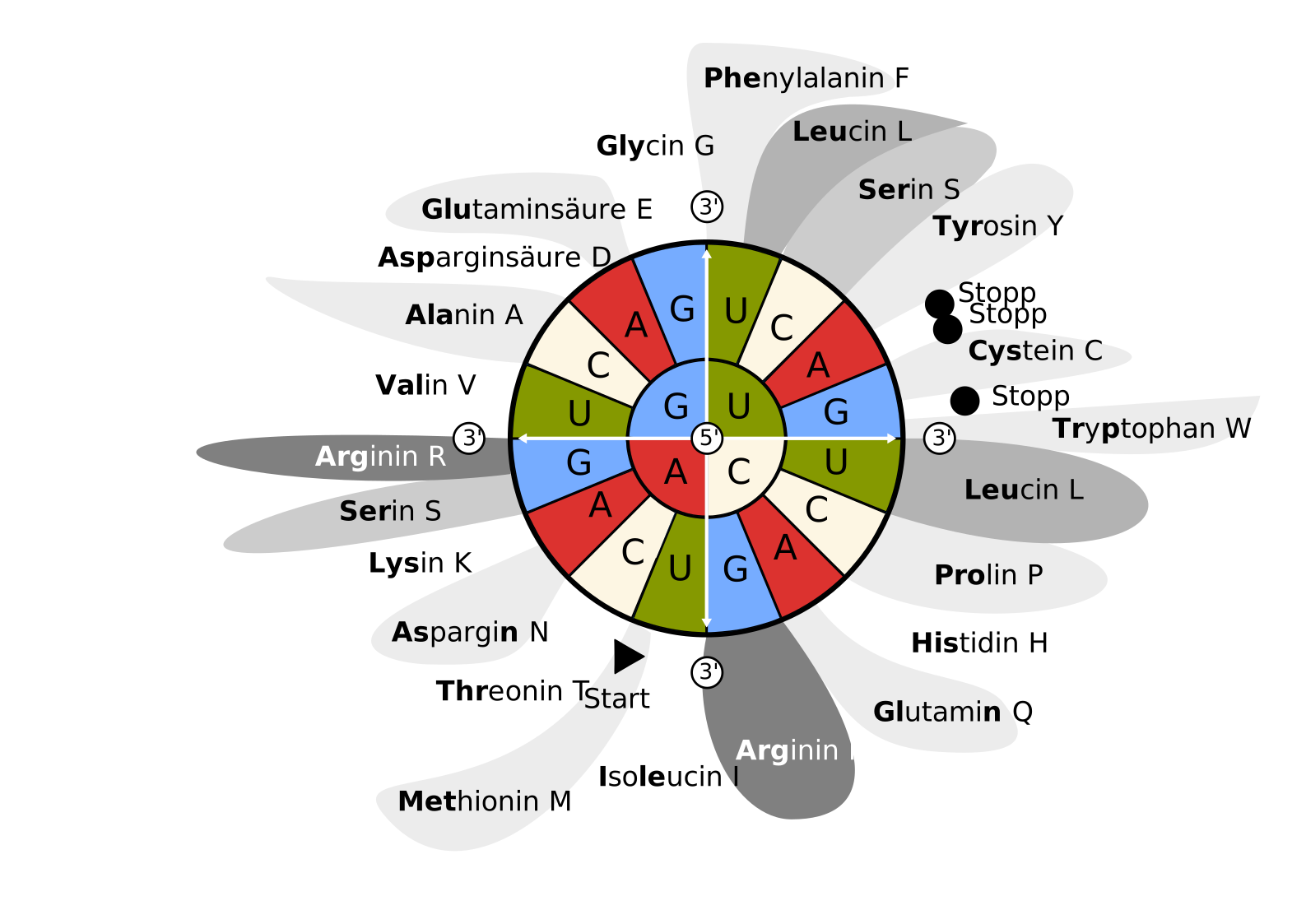
1 · What is actually in the cell
This part is not in dispute; it is molecular biology. DNA stores instructions in a four-letter chemical alphabet. The cell reads them three letters at a time; each three-letter "word," or codon, specifies one amino acid, and a chain of amino acids folds into a protein. There are 64 possible codons mapped onto 20 amino acids plus start and stop signals: a genuine lookup table, nearly the same in every organism on Earth. The information density is staggering: the instructions to build a human are written in about three billion of those letters, and a few grams of DNA could in principle store the world's data. Scientists do not reach for the language of code as poetry. They speak, accurately, of transcription, translation, proofreading, error-correction, start and stop codons, and genes switching one another on and off. The cell really is an information-processing system.
2 · The design argument, at its strongest
Here is what gives the argument its teeth, and it is a specific, technical point, not a vague "it looks complicated." The mapping from codon to amino acid is largely arbitrary: chemically, the letters do not have to mean what they mean. It is a convention, like assigning dots and dashes to letters in Morse code, or bytes to characters in a computer. Francis Crick, who helped crack the code, called it a "frozen accident" precisely because the assignments are not forced by chemistry. And that is exactly the property that makes human codes the work of minds: a code is a set of conventions linking one thing to another by rule rather than by necessity. Stephen Meyer, in Signature in the Cell, presses the point: what needs explaining is not mere complexity, and not mere improbability, but specified, functional information: sequences that are both highly improbable and arranged to do something, the way a sentence is, and unlike random letters. In all of human experience, that kind of thing has exactly one known source: intelligence. The inference is to the best explanation: code points to a coder.
3 · The strongest objections, fairly stated
Now the replies, and they are not throwaways.
- "Code" may be a metaphor we are over-reading. This is the deepest objection. When you say DNA is "like" computer code, you are reasoning by analogy, and analogies can mislead. The codon-to-amino-acid mapping is not enforced by an abstract convention floating free of matter; it is carried out by physical molecules, transfer-RNAs and the enzymes that charge them, that bind by ordinary chemistry. A critic can say: this is not a language in the human sense, with a mind intending meanings; it is a very sophisticated chemical relay that we find useful to describe in the borrowed words of information technology. Calling it a "code" does not, by itself, prove a coder; it may smuggle the conclusion in through the metaphor.
- The code is not a pure accident: it looks shaped. Against Crick's "frozen accident," later work found the codon table is strikingly non-random: similar codons tend to specify similar amino acids, so that a typical copying error changes the protein little. The code appears optimized to minimize the damage from mutation. To a biologist that points not to a one-shot design but to a code refined by natural selection over time: an argument that the structure has a natural-historical explanation.
- "Specified information" is hard to pin down. Critics charge that the notion of "functional/specified information" at the center of the design argument has never been given a rigorous, agreed measure: that "specified" quietly means "the kind of arrangement that needs a designer," which would make the argument circular. And they note that ordinary processes can demonstrably add functional information in the small (gene duplication and selection, treated on the macroevolution page), so "only minds make information" is too strong as a blanket claim.
4 · Where it actually stands
Weigh those honestly and the picture is neither a knockout nor a dismissal. The metaphor objection has real force, and a careful believer should not pretend "DNA is literally a language, therefore God" settles anything; the analogy is suggestive, not a proof, and pressing it too hard is its own kind of overreach. But the analogy is also not nothing, and here is why it keeps its grip: the arbitrariness is real, the lookup table is real, the start-and-stop control logic is real, the proofreading is real. These are not features chemistry needs; they are the features of a system that processes symbols. And the error-minimization reply, strong as it is, explains how an existing code might be refined; it does not explain how a symbol-processing convention arose in the first place, before there was any translation system to be selected, which lands us back, exactly, at the unsolved origin-of-life problem, now sharpened: not just "how did the chemistry start?" but "how did a coded, rule-governed chemistry start?" The deeper biology looks, the more language-like the cell appears, and that is the opposite of what you would expect if the code-talk were merely a loose metaphor about to dissolve.
The cell runs on something that behaves like a code: an arbitrary, rule-based mapping with stored instructions, proofreading, and on-off switches. Maybe that is only a powerful metaphor for clever chemistry; the objection is fair and should be granted its weight. But maybe a thing that stores, reads, and executes coded instructions is exactly what it looks like, the work of a mind, and the case for that reading grows, not shrinks, the more we learn about the genome. Hold it as the strong inference it is, not the proof it isn't.
The honest verdict
Of the arguments in this section, this is the one I find most quietly compelling, and the one I am most careful with, both for the same reason. It is compelling because it does not depend on a gap or a failure of science; it depends on a positive feature of the most-studied molecule on Earth, a feature that becomes more striking, not less, as the science advances: the cell stores and runs coded information. It needs care because its whole force lives in an analogy, and analogies are where honest arguments most often overreach. So I will not say the genetic code proves a Designer; a thoughtful person can hold that "code" is our useful metaphor for an extraordinary chemistry, and follow the science to see how far that goes. What I will say is that reading a Mind behind a system that writes, proofreads, and executes instructions in an arbitrary symbolic alphabet is a reasonable inference, arguably the most reasonable one, and that it is offered here as an inference, not a closed case. And it is, once more, an old reading made newly vivid. "In the beginning was the Word" (John 1:1): the Logos, reason and language itself, the One by whom "all things were made" (John 1:3). That the deepest layer of every living thing turns out to be written in a language does not prove that verse. It is, yet again, precisely the kind of thing the verse would lead you to expect.
See also Specified Complexity, Dembski’s formal version of this. Sources are summarized, not reproduced. The molecular facts (the four-letter alphabet, 64 codons mapped to 20 amino acids, the near-universal and largely arbitrary code, transcription/translation/proofreading) are standard molecular biology. "Frozen accident" is F. Crick (1968); the error-minimization / non-randomness of the code is from the subsequent optimization literature. The design-from-information argument and the Shannon-versus-specified/functional-information distinction are from S. Meyer, Signature in the Cell (2009), and W. Dembski; the metaphor critique and the "specified information is undefined / natural processes add information" objections are the standard replies. Scripture from the King James Version, linked to BibleHub. This page offers the design inference as a reasonable inference from a positive feature of the cell, explicitly not as a proof or a god-of-the-gaps argument.