Did We Come From Apes?
The hominid fossils are real; the straight line from ape to man is the inference
Of all the questions about origins, this is the one that comes nearest the bone, because it is not about rocks or starlight but about us. So I want to go slowly and give the other side its full due. Let me grant everything that can honestly be granted, state the mainstream case at its strongest, and only then say where I think the famous straight line from ape to man is an interpretation laid over the fossils rather than something read out of them. The fossils are real. I have no interest in pretending they are fakes, or that there is nothing here to explain.
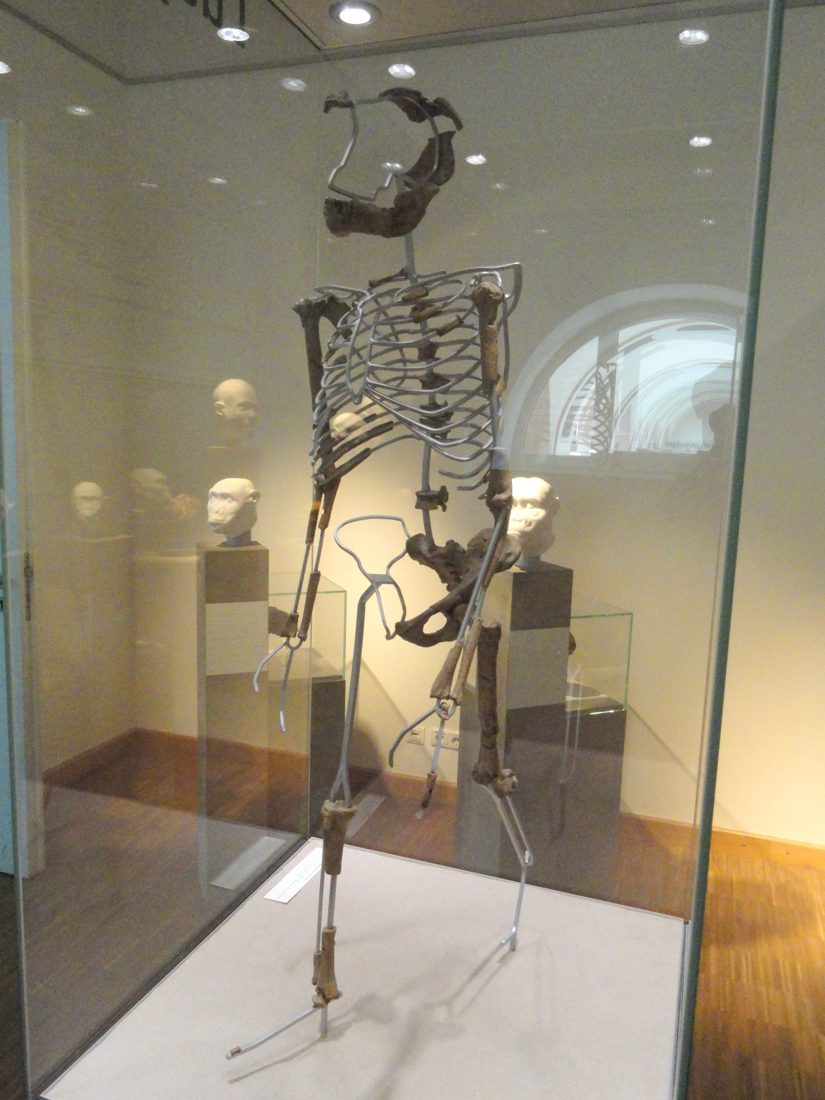
1 · What is not in dispute
The fossils exist, and they are roughly what we are told they are. There was a creature called Australopithecus afarensis, "Lucy" is the famous one, and the Smithsonian dates her kind to between about 3.85 and 2.95 million years ago on the standard scale, with a brain "usually less than 500 cubic centimeters — about 1/3 the size of a modern human brain." There were Neanderthals, who lived, the same source says, from about 400,000 to 40,000 years ago. I am not going to win anything by calling these bones a hoax; most of them are exactly what they appear to be, and the close anatomical and genetic likeness between humans and the great apes is real and not in question. Any honest account starts there.
2 · The claim I am actually making
Here is the narrow thing I actually dispute. Lay the famous fossils out and, to my eye, they do not form a smooth ramp; they cluster. On one side sit the australopithecines: upright, yes, but small-brained and, in the Smithsonian's own words, with "apelike face proportions" and "long, strong arms with curved fingers adapted for climbing trees." On the other side sit Homo erectus and the Neanderthals, who by every cultural measure were people. The straight line that turns the first group into the second, that is the inference. My claim is not that the bones are fake, or that there were never upright apes; it is that reading a drawer full of apes and a drawer full of humans as a single line of descent is an interpretation, and a contested one, not a thing you can simply see.
3 · The mainstream case, at full strength
I have to put this strongly, or I am not being fair. Lucy was not a knuckle-walking chimp. The Smithsonian says her species "stood on two legs and regularly walked upright," and the Laetoli site in Tanzania preserves what it calls "the oldest documented bipedal footprint trails": actual footprints, pressed into volcanic ash, with a human-like stride, left by a small-brained creature. That is a genuine mosaic: an upright gait on an ape-sized brain, which is exactly the sort of in-between the theory predicts and would be embarrassed to lack. The Neanderthals press harder still. They "made and used a diverse set of sophisticated tools, controlled fire, lived in shelters, made and wore clothing," and "deliberately buried their dead and occasionally even marked their graves with offerings, such as flowers", with brains "just as large as ours and often larger." And mainstream genetics now says they "interbred with non-African modern humans." A fair person has to feel the full weight of this before saying a word back.
4 · Where the popular creation arguments go wrong
And before I say it, I have to set down the bad arguments on my own side, because they are the reason this position gets laughed out of the room.
- The fraud stories prove the opposite of what they are used to prove. You will hear that human evolution rests on hoaxes: Piltdown Man and Nebraska Man. Both stories are true, and both cut the other way. Piltdown Man, announced in 1912 as the missing link, really was a forgery: a medieval human skull joined to a roughly 500-year-old orangutan jaw. But it was not creationists who caught it. Mainstream scientists at the British Museum, Oakley, Le Gros Clark, and Weiner, exposed it in 1953 with a new fluorine-dating test. Nebraska Man was briefer and sillier: in 1922 a single tooth was named as an ape-man, and by 1927 its own describers had retracted it in the journal Science: the tooth had belonged to an extinct peccary, a kind of pig. These are not proof that the establishment hides the truth; they are proof that it corrects its own mistakes. To wave them around as if evolution stands on fraud is to argue dishonestly, and it forfeits any right to ask the other side for honesty.
- Do not say Lucy was "just a chimp." The pelvis and the Laetoli footprints say she walked upright, and denying it only shows you have not looked. Concede the upright gait; the real question lives elsewhere.
5 · Where the case for a line still stands
With that underbrush cleared, here is what I think genuinely remains. The fossils really do tend to sort into two groups rather than one gradient. Answers in Genesis states the creation reading bluntly: the specimens are "either human or ape, not an in-between species." As a flat fact that overreaches: the mosaic creatures are real, and Lucy's upright walk on a small brain is exactly the kind of thing the slogan wants to wish away. But as an interpretation it has teeth: the australopithecines function, in brain and hand and tooth, as apes that happened to walk; the Homo fossils function as people; and the forms that sit cleanly between are fewer and more disputed than the textbook ladder suggests. The Neanderthals are the sharpest case of all. The more we learn, the more human they look: burying their dead, making ornaments, and, the same mainstream science now grants, interbreeding with us. Here creation and consensus very nearly meet: Answers in Genesis is content to say what the genetics increasingly says, that Neanderthals "were fully human." And when the celebrated "ape-man" turns out to be a people our own ancestors could and did marry into, the line between ape and man has not been crossed; it has only been moved. Underneath all of it is the quiet point this whole section keeps making: a sequence of similar bones is data, but reading it as a chain of ancestors and descendants, rather than a gallery of separately-made creatures, some of them extinct apes and some of them early men, is an interpretation laid over the data, not the data themselves.
The honest verdict
So, plainly. The hominid fossils are real, and some of them, upright Lucy with her small brain, the cultured Neanderthals, are genuinely arresting; no one keeps any credibility by calling them fakes, or by leaning on Piltdown and Nebraska Man, which mainstream science itself threw out. What I hold, and hold honestly, is that the bones cluster more than they ladder; that "human ancestor" is an interpretation of a fossil and not a label you can read off it; and that the most famous "ape-man" of all, the Neanderthal, looks more like a brother every year. The data are shared. Whether they form a single line of descent, or a gallery of created kinds (some extinct apes, some early men) is the conclusion drawn over them, and that is where the real disagreement lives.
I read man as made, not merely arrived. "So God created man in his own image" (Genesis 1:27); "and the LORD God formed man of the dust of the ground, and breathed into his nostrils the breath of life; and man became a living soul" (Genesis 2:7). I hold that as a faith reading, and as a reasonable inference from a record that clusters rather than flows, not as a laboratory proof, and not with any contempt for the Christian who reads the same bones and the same Scripture another way. The age of the earth and the route of creation have never been the hinge of the faith; the dignity of man, made and breathed into by God, is.
Sources are summarized, not reproduced. Mainstream evidence: the Smithsonian Institution's Human Origins Program pages on Australopithecus afarensis (the 3.85–2.95-million-year range, the brain "less than 500 cubic centimeters — about 1/3 the size of a modern human brain," the upright walk, the Laetoli "oldest documented bipedal footprint trails," and the "apelike face proportions" with "curved fingers adapted for climbing trees") and Homo neanderthalensis (the brains "just as large as ours and often larger," the tools, fire, clothing, and deliberate burial "with offerings, such as flowers," and the interbreeding with "non-African modern humans"). Creation case: the "either human or ape, not an in-between species" classification of the hominid fossils, and the judgment that Neanderthals "were fully human" (Answers in Genesis). The Piltdown Man forgery (announced 1912; exposed by British Museum scientists in 1953 by fluorine-absorption dating; a medieval human skull with an orangutan jaw) and the Nebraska Man error (named 1922 on a single tooth; retracted by its describers in Science in 1927; the tooth from an extinct peccary) are matters of documented record. Scripture from the King James Version, linked to BibleHub. This page weighs the evidence and states a faith reading as a reasonable inference, not a tested, repeatable result.